
The Price Is No Longer Yours to Set: What 11,365 Plumbing Reviews Reveal About the End of Pricing Opacity
- AJ Sangwan
- Mar 6
- 7 min read

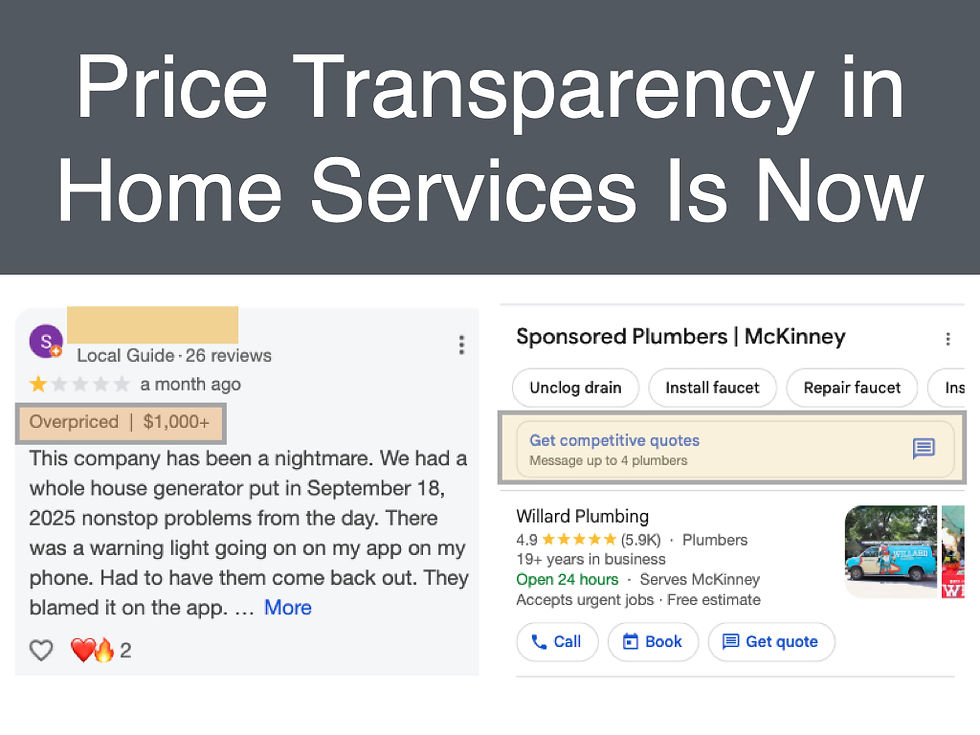
A year ago, we predicted AI-driven price transparency would reshape home services. Here's the data that proves it already has.
A year ago, Peakzi published an article arguing that AI would force price transparency onto the home services industry. We described a homeowner whose AI assistant compared dispatch fees across five HVAC providers and eliminated two before the homeowner even picked up the phone.
That was a hypothetical. This is not.
We now have data from 11,365 real plumbing reviews across 253 companies nationwide. These are homeowners who voluntarily told Google whether the price they paid felt fair, reasonable, or too high. What emerged isn't a theory about where pricing is headed. It's a map of where pricing already is.
The Opacity Era Is Over
Home services has always run on information asymmetry. The homeowner has an urgent problem and no context for what the fix should cost. The contractor shows up, builds trust in the moment, and the price feels fair because the person feels competent, not because the homeowner has any idea what the market rate actually is.
That model worked for decades. It's breaking now, and from every direction at once.
Ask any AI assistant what a fair price is for a water heater install in your city. ChatGPT, Claude, Gemini, Perplexity. You'll get an answer. Millions of homeowners are already asking.
Google has gone further. A new feature on Google Business Profiles now captures and surfaces homeowner sentiment about pricing, categorizing reviews by whether homeowners perceived the price as a great value, reasonable, or overpriced. This is no longer buried in review text. It's structured data. Google's Local Services Ads now include an AI feature that calls contractors directly to gather pricing, literally phoning your business to ask what you charge and adding that information to its index.
And autonomous AI agents that can contact dozens of companies, compare quotes, and negotiate on a homeowner's behalf are not science fiction. The tools exist today. Search is evolving from list-based discovery to agent-assisted filtering.
The shift is fundamental. You are being ranked at the data layer, based on what homeowners say about your pricing, service by service, in their own words.
What 11,365 Plumbing Reviews Actually Reveal
At Peakzi, we analyzed 11,365 price-signal reviews across 253 plumbing companies nationwide, covering every company with at least 25 reviews where homeowners mentioned pricing. Companies with insufficient pricing signals were excluded to prevent distortion from small samples. We scored each company using Bayesian methods with national priors and broke the data down by service item, going beyond "is this company well-priced?" to answer "is this company well-priced for drain cleaning vs. toilet repairs vs. water heater installs?"
The Price Gap Is Real and It's Massive
For the six most common plumbing services, we compared average estimated prices at top-perceived companies (the top 30 nationally) against bottom-perceived companies (the bottom 30):
Service | Top-Perceived Avg Price | Bottom-Perceived Avg Price | Gap |
Drain Cleaning | $167 | $493 | 3x |
Toilet Repairs | $260 | $481 | 1.8x |
General Plumbing | $188 | $421 | 2.2x |
Pipe Repair | $375 | $615 | 1.6x |
Water Heater Repairs | $264 | $475 | 1.8x |
Leak Detection | $267 | $467 | 1.7x |
Drain cleaning shows the most dramatic gap: homeowners at top-perceived companies pay $167 on average while bottom-perceived companies charge $493. While scope and urgency vary across individual jobs, the perception gap remains directionally consistent across markets. The cheaper companies are also the ones homeowners feel best about.
Price Perception Is Service-Specific, Not Brand-Specific
This is the most important finding in the entire dataset.
Take Any Hour Services in Orem, Utah, ranked #2 nationally with a strong overall price perception score. Their drain cleaning service is exceptional: 75% of price-mentioning homeowners called it a great value at $118 average. But their toilet repairs tell a different story: 26% of homeowners flagged them as overpriced at $234 average.
Same company. Same technicians. Same brand. Completely different price perception depending on which service the homeowner bought.
This reframes the pricing question entirely. It's not "Are we expensive?" It's "Where exactly are we under pressure?" A company's aggregate reputation can mask significant service-specific problems. You might be winning on drain cleaning and bleeding on toilet repairs, and your overall score looks fine, so you never investigate.
Homeowners Reward Fair Pricing More Than They Punish High Pricing
Of the 253 plumbing companies in our dataset, only 3 scored as genuinely overpriced. The vast majority, 250 out of 253, scored as great value or mixed/neutral.
Homeowners are far more likely to praise a fair price in a review than they are to complain about a high one. When the price feels right, homeowners go out of their way to mention it. When the price feels high, most homeowners just quietly don't come back.
The absence of pricing complaints doesn't mean your pricing is fine. It may mean homeowners are voting with their feet instead of their words.
The Franchise Pattern Is Unmistakable
The pattern is not brand-wide. It's location-specific. The same franchise model produces opposite perception outcomes depending on the local market.
Len The Plumber occupies three of the bottom five spots nationally (Silver Spring, Boothwyn, and Horsham) with overpriced shares of 21 to 25%. Roto-Rooter appears four times in the bottom 30 across Chicago, Sacramento, Saint Paul, and Blue Springs. Meanwhile, Rooter Hero holds three spots in the top 10 (Antioch, San Diego, and Phoenix) with great value shares of 50 to 59%. ARS/Rescue Rooter appears twice in the top 5 in San Leandro and Indianapolis.
These are location-specific outcomes, not judgments on corporate pricing strategy. Price perception is determined by what the homeowner experiences at that location, and whether that experience matches what the local market considers fair.
The Worst-Perceived Company in the Country Tells the Whole Story
Four Seasons in Chicago sits at rank 253 out of 253, with 31% of homeowners flagging them as overpriced. But even here, the service-item breakdown reveals the real picture. Their water heater service actually has positive perception (29% great value, only 14% overpriced). It's their drain cleaning (43% overpriced at $400), leak detection (60% overpriced at $700), and general plumbing (50% overpriced at $350) that sink the overall score.
Four Seasons doesn't have one pricing problem. They have three specific pricing problems and one service that's working. Without the service-item breakdown, they'd never know where the actual issue lives.
This Is Just the Beginning
These findings come from barely two months of structured pricing data since Google began surfacing price perception signals. Two months produced 11,365 reviews with clear sentiment across 253 qualified companies.
In twelve months, this dataset will be dramatically deeper. The benchmarks will become more granular, moving into neighborhood-level, service-complexity, and seasonal patterns. And as this data accumulates, it will directly influence which contractors algorithms recommend and which ones get filtered out before the homeowner ever sees them.
Every quarter, the data gets richer and the algorithms get smarter. When price perception drifts materially from local benchmarks, visibility declines before revenue does. By the time it shows up in the P&L, the algorithm has already re-ranked you.
What Every Contractor Needs to Do Right Now
The temptation is to read this and think "race to the bottom." It's not. You don't need to be the cheapest. You need to know where you stand, defend where you're weak, and lead where you're strong.
Not your aggregate rating. Your service-by-service price perception.
Calculate the percentage of reviews mentioning price for each service you offer. Flag any service where more than 20% of those reviews signal overpriced sentiment. Compare against your metro benchmarks. Track quarterly.
If you're a PE-backed operator running multiple locations, this becomes portfolio-wide perception variance analysis. Benchmark standardized pricing against local sentiment across every market you serve. Identify where margin is leaking before it shows up in the P&L.
If you're an owner-operator, the question is simpler but just as urgent: which of your services is losing you jobs before the phone even rings?
2. Defend Where You're Weak
If your price perception is negative on a specific service, the answer isn't always to cut prices. It's to provide proof that justifies the price: quality of workmanship, premium materials, extended warranties, faster response times.
The critical shift is that proof needs to exist before the homeowner calls. In the old model, you justified your price face-to-face. In the new model, the algorithm is filtering you out before that conversation ever happens. Your justification needs to be visible in your reviews, your website, your Google profile. Make the "why" behind your price as visible as the price itself.
3. Market Where You're Ahead
If homeowners are telling Google your drain cleaning is a great value, that's a competitive weapon. "Top-rated value for drain cleaning in Charlotte," backed by real homeowner sentiment data, is the kind of claim that algorithms can verify and amplify. Most contractors market on trust, speed, and quality. Very few market on price perception, because until now, there was no credible way to do it. That's changed. The companies that claim it first win twice: once with the homeowner who sees it, and once with the algorithm that confirms it.
The New Category: Algorithmic Reputation Management
You're not just managing your reputation anymore. You're managing how your reputation is interpreted by machines.
That's a new discipline. It combines pricing perception, service-level strength, structured data completeness, and market benchmarking into a single picture of how algorithms see your business. We call it your AI-Readiness Score: a composite measure of whether your pricing, your review sentiment, and your data footprint are positioned to win in an algorithmically mediated market, or quietly suppressed before the homeowner ever sees your name.
We see this variance across markets every week. Most operators have no idea how they score.
The contractors who thrive in this environment won't be the cheapest. They'll be the ones whose pricing is defensible at the data layer, whose quality claims are verified by homeowner sentiment, and who know exactly where they stand on every service they offer.
The market is no longer setting price in the living room. It's setting it in the data.
At Peakzi, we saw this shift coming a year ago. Now we're building the intelligence behind it. Run your service-level perception score. See your AI-Readiness Score. Compare against your metro. If you don't know your score, the market does.

