If AI Can't Explain You, You Don't Exist
- AJ Sangwan
- Apr 29
- 8 min read

Updated: Apr 30

If AI Can't Explain You, You Don't Exist
From the Peakzi AI webinar featuring Bubba Thurman (President, Baker Brothers), Gus Antos (Owner & Co-Founder, Milestone), Amanda Swartz (CMO, Cascade Services), and Karen Osburn (VP of Product & Operations, Peakzi AI), moderated by Bijan Parvin. Watch the full session here.
Organic traffic isn't declining. It's being intercepted.
A declining channel gives you time. An intercepted channel means the customer already got an answer before they reached you. That's what AI search is doing to home services right now, and a recent Peakzi webinar with operators from Baker Brothers, Milestone, and Cascade Services made it impossible to ignore.
The conversation was candid, the consensus was real, and the most important conclusions were circled without being named directly. This article names them.
Most contractors would be surprised by how AI currently describes their business and who it recommends instead.
What Everyone Agreed On
PPC is no longer a growth engine. Bijan opened by naming what contractors nationwide have been reporting: pay-per-click costs are rising, returns are falling, and Google Local Service Ads keep changing the rules mid-game. Bubba Thurman, president of Baker Brothers, confirmed it from the operator side. "Since 2022, calls have been a challenge," he said. The channel still has a role, but it's not the lever it was.
Zero-click search is not coming. It is here. Karen Osburn, Peakzi's VP of Product and Operations, set the stage early: "AI is not changing how you get found. It's changing how you get judged." Before, customers did the work, clicking through websites, reading reviews, comparing options. Now AI is doing that filtering for them. Amanda Swartz, CMO of Cascade Services, put real numbers behind it: "We're seeing a decline in organic traffic across several of our brands as consumers begin to shift how they find out about our businesses." That shift is not a blip. It's structural.
AI has entered the in-home sales conversation. Bijan raised something every operator in the room recognized: homeowners are now price-checking technicians while those technicians are still in the home. Gus confirmed it — the in-home consultation, once a controlled sales environment, now has a third participant with its own data and its own framing of what fair looks like. That's a structural change to the sales process, not a marketing problem.
Reviews matter, but how they reach buyers is changing. Milestone has nearly 40,000 Google reviews at 4.9 stars, and Gus raised the question that stopped the room: "I don't know that these 40,000 Google reviews are going to end up mattering. We spent the last 10 years gathering them all, and now it's all changing so fast." The reviews don't disappear, but the mechanism that made them powerful is being replaced by an intermediary that decides what to surface.
Where They Pushed Back on Each Other
Price transparency: the issue that dominated the room
This was the most contested and most honest ground of the session. It consumed nearly half the conversation, and for good reason. AI is forcing the most uncomfortable change in how home services companies operate, and pricing is right at the center of it.
Bubba held the traditional operator position: "We do everything we can to not give a price. We try to really explain to the homeowner why that's not good for them." His reasoning is sound: too many variables, too much risk of misrepresentation. That logic has held for decades.
But consider what AI does with that silence. A homeowner searches for the best AC repair near them that won't overcharge. Company A says they care about their customers and believe in honest service. Company B lists a 4-hour response window, flat-rate diagnostics, a 5-year parts warranty, and pricing ranges for common repairs on their site. AI doesn't debate. It selects. Company A gave it nothing to work with, and Company B gave it exactly what it needed.
In AI search, no pricing information doesn't read as thoughtful. It reads as absence, and absence doesn't get recommended.
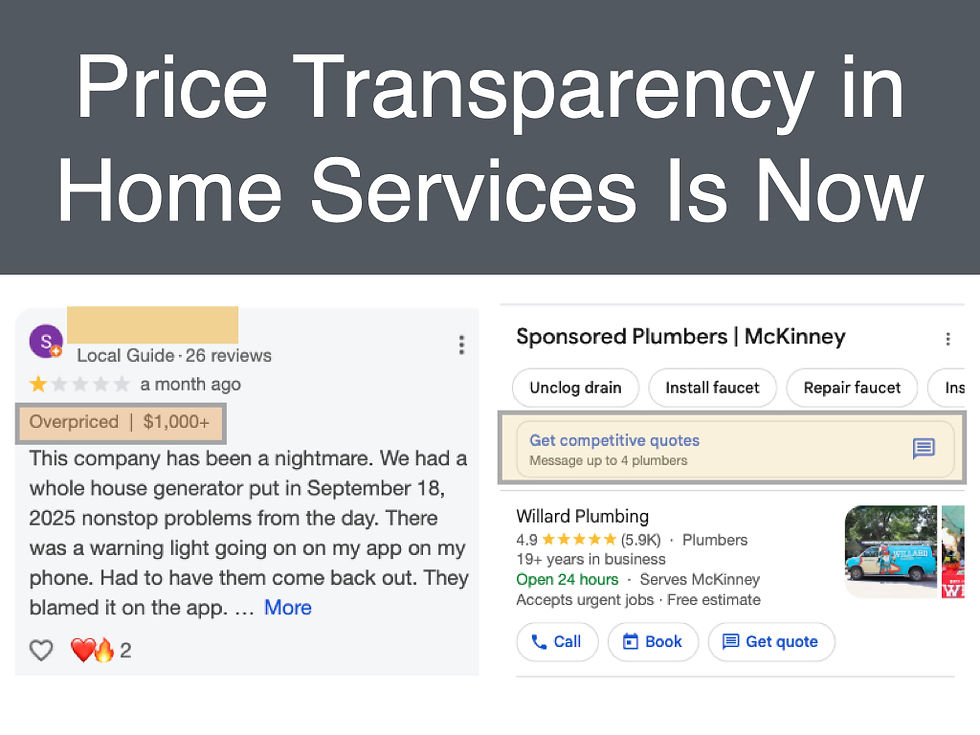
The stakes got sharper when one panelist described a customer who called, was not given pricing over the phone (standard industry practice) and immediately left a one-star review. The technician did nothing wrong, but the customer's expectation had already been shaped by a world where AI delivers answers on demand. That review is now part of the contractor's data footprint, and AI will read it.
Amanda put the industry's discomfort plainly: "This is a pain point for us and I think for the industry too. What we don't want is customers just looking for the cheapest price, because there's so much complexity and different factors that weigh in on the cost." Cascade's businesses hesitate to even quote over the phone — they want to get into the home first. But Amanda acknowledged the pressure isn't going away: "We may not have a choice down the road."
Gus flagged what's coming next: Google is piloting an AI agent that will call contractors on behalf of homeowners, ask about pricing and availability, check reviews, and book the appointment without the homeowner ever picking up a phone. "I hear that and I just want to get into another industry," he said. "But it is what it is. We're going to have to deal with it."
The panel's practical resolution was this: you don't need to publish a price list, but you do need legible pricing. Ranges, variables, context, enough for AI to relay something accurate rather than fill the silence with big-box estimates or competitor data that doesn't represent your value. Gus admitted the bind honestly: "I'm talking in circles because I really don't know what to expect." But the direction was clear: give AI something to say, or it will say something else.
This is exactly where Peakzi focuses. The pricing transparency layer Peakzi builds structures your pricing directly into your AI-readable digital presence: consistent, defensible, and aligned with how you actually price in the home. When homeowners ask AI for a reliable HVAC company, your pricing reinforces the recommendation rather than raising a red flag.
Do premium companies lose to budget competitors in AI recommendations?
Bijan posed this directly, and the panel landed on a clear answer: premium companies need to give AI specific, factual reasons to recommend them: certifications, response time guarantees, warranty terms, service breadth. Not brand promises. Verifiable facts.
Bubba put it plainly: "You can't be fast, do high quality, and be cheap. I'm really not going to compete against the cheapest guys." The path forward isn't price matching. It's making quality and speed legible to the machines making the first recommendation.
Gus reinforced it from experience: "I very rarely, almost ever, find a company who's operationally excellent and has a long-term marketing problem." The companies winning in AI search aren't marketing their way there. They're operating their way there and making sure AI can see it.
Brand is being compressed into structured data. Marketing built for human emotion doesn't survive the AI intermediation layer. What survives is precision: FAQs, service-specific content, technician profiles, and pricing signals that AI can extract and relay accurately.
The AI Visibility Stack
The panel described the right tactics without packaging them into a framework. Based on Peakzi's work with contractors navigating this shift, here is what determines whether AI recommends you or routes around you.
Coverage. AI cannot recommend what it cannot find. Service pages, FAQs, blog posts, and review responses together create the breadth of signal AI needs. A single optimized homepage isn't enough. Amanda's team at Cascade is already rewriting blogs to be more conversational, centered on questions customers are actually asking AI, and piloting Peakzi AI websites across several brands to build that structured presence from the ground up. Gus described doing the same at Milestone: "We're constantly typing into ChatGPT — what do you know about Milestone? We're looking everywhere up and down, focusing on what information we can put out there. Let's tell the story that's actually right."
Precision. Vague content doesn't get surfaced. Name exact systems, certifications by issuing body, service areas by zip code, and specific response time commitments. General claims don't transfer. Specifics do.
Structure. FAQ formats and direct question-and-answer content get picked up more reliably than narrative brand copy. AI isn't reading for tone. It's parsing for extractable facts. This is why the FAQs and blogs Peakzi generates for contractors are built around the exact questions homeowners are asking right now, not what ranked in Google two years ago.
Proof. Reviews, guarantees, credentials, and certifications are factual claims AI can relay. A company with a 5-year parts guarantee and a 4-hour response window gives AI something specific to say. "We stand behind our work" gives it nothing. Bubba made this real when he talked about Baker Brothers' 80-year legacy: the company can't coast on history alone. "The people using us today care about what service they receive tomorrow," he said. Reputation has to be earned in every home, and AI is now the scorekeeper.
Talent. This one surprises most operators, but Karen made it explicit in the session: your technicians aren't behind the scenes anymore. They are the brand. Karen framed it directly: "culture isn't internal — it shows up in every home your team walks into." Bubba echoed it from 25 years on the operator side: "Culture isn't what you say, it's how you show up in the home. That is a really powerful truth." AI is reading your reviews for patterns in how technicians communicate, show up, and deliver, and that picture is forming whether you're paying attention to it or not. Peakzi gives technicians the ability to claim their own profiles, see how they're perceived, and understand how they're ranked in their market. That's not just a retention tool. It's a visibility signal. The companies winning on talent are the ones where individual technician reputation is being built deliberately, not left to chance.
If the machine can't explain you, the customer never hears about you.
The Real Shift (They Circled It, But Didn't Name It)
Karen framed the core problem early in the session: "The companies struggling aren't lacking leads, they're lacking alignment. They're saying one thing in their marketing, pricing another way in the home, and delivering a completely different service in the field. And AI is picking up on that disconnect immediately."
Google Search was a distribution layer. AI search is an interpretation layer, and the difference is not incremental. Distribution layers send traffic to whoever earns it. Interpretation layers decide what the answer is and deliver it directly. You no longer control the last step of your customer's discovery. An AI does, based on what it can extract and verify from your digital presence.
Bubba put the cultural weight of that into words: "AI has forced us to look at ourselves and go: we can't hide behind a logo. We can't even hide behind 80 years. The people using us today care about what service they receive tomorrow. That's how we're going to be judged."
Gus landed the practical truth: "The person at the end of the day that sends a great technician inside of the home, that does what they say they're going to do at a fair price — that company's going to keep winning."
And Karen closed the loop: "This isn't a marketing adjustment. It's a business shift. You either get ahead of it or you get filtered out by it. You can't outspin the shift. You can't out market it. You can only out execute it."
The companies that win treat their digital presence as a data source, not a brochure. The question isn't what does this page say to a person browsing, but what can AI extract from this page to accurately describe us to someone with a specific problem. SEO alone is no longer the game. AI ingestion is. Marketing teams optimizing only for human readers are already behind.
See How AI Is Describing Your Business
Some contractors are already being recommended more often because AI can clearly explain their pricing and service differences. Most don't realize they're already being skipped.
Peakzi's mission is to help home services contractors navigate AI disruptions and emerge as winners in the AI marketplace. In a short demo, we'll show you, live, how AI currently describes your business, where you're losing visibility on pricing-related queries, which competitors are getting selected instead, and what they're doing differently. No prep required. We'll pull everything in real time.
Not ready for a demo? Get your free AI Visibility Score and see exactly how AI sees your business today. Get your free score.
Want to go deeper? Start with the Peakzi podcast at podcast.peakzi.me — real operators, real markets, no fluff — and join the monthly webinar series at peakzi.me/webinar. Both are free.
The discussion referenced in this article was part of Peakzi's monthly webinar series and featured Bubba Thurman (President, Baker Brothers), Gus Antos (Owner & Co-Founder, Milestone), Amanda Swartz (CMO, Cascade Services), and Karen Osburn (VP of Product & Operations, Peakzi AI), moderated by Bijan Parvin.